RadPad Home Service Pros
42 pages. Six service lines broken out into their own pages, eleven city pages, and every old URL redirected so nothing lost its ranking.
It can't warn you about the decision you didn't know you had to make. This playbook puts every one of those decisions in front of you, in order.
Instant download. All sales final.
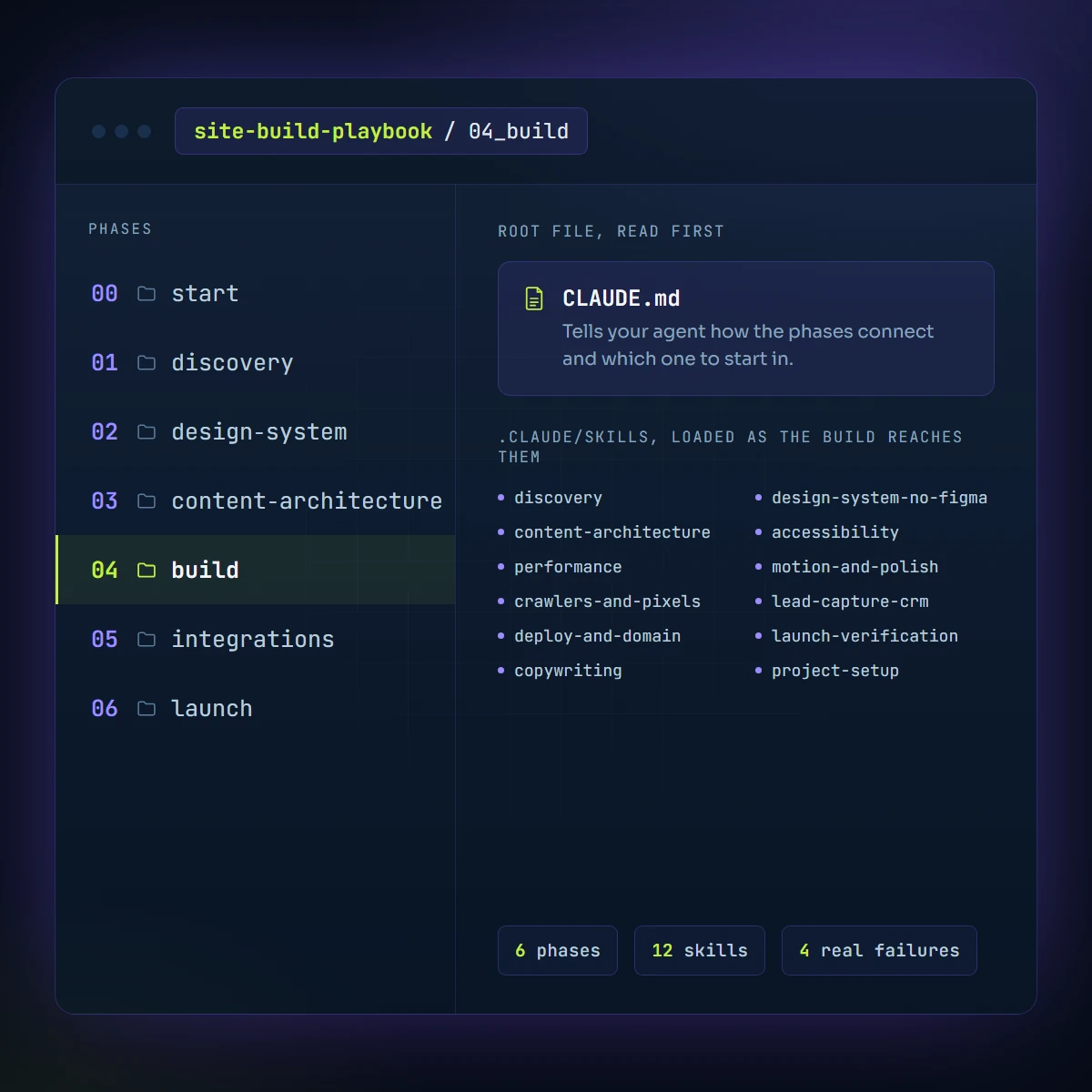
Plus 12 skills your agent loads as it reaches each phase, a reviewer that checks every phase before you move on, and 4 real launch failures with the fix.
We are super impressed with the site you built for Jett’s! I honestly think many of our users would benefit from your work.
He sets the standard for what an outstanding developer should embody. Our very next statement was always: ask Ignacio.
Top of the line. His skills go above and beyond, and he has the utmost professionalism with each client. I recommend him to everyone I know.
These are clients of the builds this method came out of, not buyers of the playbook. It went on sale this month.
Without a set order, the work happens in the wrong one. A question nobody flagged gets skipped. A design gets picked by taste at midnight and re-picked the next night. Then weeks later something breaks that was really decided back in week one.
The cost is not the code. It is the re-deciding, and the cleanup.
Most guides describe the happy path. This one is mostly scar tissue: what actually went wrong on real launches, what it cost, and how to catch it before it ships. Four of them are in here as their own sections, with the diagnosis and the fix.
A site where every lead form redirected to a 404, so the conversion tag never fired and ad spend optimized against data that was never collected.
A CRM integration that worked in testing and silently stopped on the first real submission, because the vendor's refresh token rotation was on.
A mobile Largest Contentful Paint stuck at 7.9 seconds where the fix had nothing to do with image size. The hero was waiting on JavaScript that had no business running first.
A robots.txt that shipped with the previous vendor's client name in it.
Drop the folder into Claude Code, say where you are, and it starts you in the right phase. Your own business or somebody else’s, same method. Each phase settles decisions the next one depends on. Skipping ahead is the single most common way a build goes wrong, and the bill arrives at launch rather than at the time.
The things only the business owner knows. The registered legal entity name, the address that has to match the Google Business Profile, which cities you will actually drive to, the exact wording of any guarantee you are willing to stand behind. No AI can invent these, and every one of them becomes a launch blocker if it is still missing in week nine. Building your own site? This phase takes an afternoon, because you are the owner.
You do not need a designer and you do not need Figma. You need eight decisions: ink and paper, one accent with a rule for where it is allowed to appear, a type pairing, a fluid type scale, a spacing rhythm, one radius, one motion signature, one photo treatment. Write them down as tokens and the rest of the site designs itself, because every later question answers by reference instead of by taste. At two in the morning you do not have taste. You have a reference.
URLs, the service silo, service-area pages. Including how to capture the SEO baseline of an existing site before you replace it, which cannot be reconstructed afterward.
Components, performance, accessibility, checked continuously instead of bolted on at the end. Retrofitting either one is several times more expensive.
Lead capture, CRM, reviews. Including the failure modes that pass testing and die in production.
Pre-launch verification, DNS, and confirming the things that look fine and are not.
Plus twelve skills the agent loads only when it reaches that work, so it is not carrying the whole method at once.
You run a real business, you would rather not hand over thousands for a website, and you already have Claude Code open. You know your business better than any agency ever will. What you are missing is the order to do things in, and the list of things that break quietly.
Freelancers and small studios doing home services, trades, clinics, restaurants. You can already build. What costs you is not knowing what to ask up front, having no design ability without a designer, and launch mistakes you only discover weeks later.
Same six phases either way. The only thing that changes is who answers the questions in phase one.
There is no code to install. Nothing to npm install. If you want a starter you can deploy today, this is the wrong product.
This is written to be handed to one. You can read it as a document, but you would be paying for something you cannot run the way it was built to run.
The design phase produces tokens and decisions, not comps. If you expect to approve a picture of the site before it exists, this will frustrate you.
If the plan is Wix or Squarespace, this is not for you and you do not need it. This is for sites that get written as code, whether by an agent or by hand.
Phase 1 exists precisely because some things cannot be generated. Somebody still has to answer the questions, and on your own site that somebody is you.
Yes, and it moves faster for you. Phase one is what stalls agency projects, because it is a list of things only the business owner can answer. You are the owner. You already have every answer, you just did not know they were needed before the build started.
You can, and it will answer confidently every single time. Getting answers was never the bottleneck. The bottleneck is the question you did not know to ask. Nothing prompts you to capture the registered legal entity name in week one. You find that out in week nine, when the site is finished and cannot go live.
No. Prompts are phrasing. This is sequence and judgment: what order to do things in, what to settle before moving on, and what specifically breaks if you do not.
It is not tied to a framework version, so there is no package to go stale. The examples lean Next.js because that is what it was extracted from, but the sequence and the decisions travel to any stack.
A folder. Six numbered phase directories plus a start folder, twelve skill files, and a root file your agent reads to work out where to start you. Plain markdown. No dependencies, no build step, nothing to maintain, nothing that can break.
If you can run an AI coding agent on a project, yes. There is nothing to install.
It is written for Claude Code. Any agent that can read a folder of markdown can follow it, but Claude Code is what it was built and tested against.
Yes. Your own business, your clients, as many sites as you build. It is licensed to you and not for redistribution or resale.
No. It is a download and you have all of it the moment you open it, so all sales are final. If you are unsure, read this page again and do not buy until you are sure.
Not screenshots. Open either one and poke at it.
The playbook is the method that built it. He is talking about the site, not the folder.
We charge $6,000 to run this method on a client's site.
$97one time
Same method. You run it.
Instant download. All sales final.
That is a completely reasonable answer. We build these sites for a living. If you got this far and decided you would rather hand the whole thing over, book a call and tell us about it.